How to Rejet Your Carburetor for High Altitude
Learn how to rejet carburetor altitude changes step by step. Includes a real WR250F example going from 500 ft to 8,000 ft with exact jet sizes.
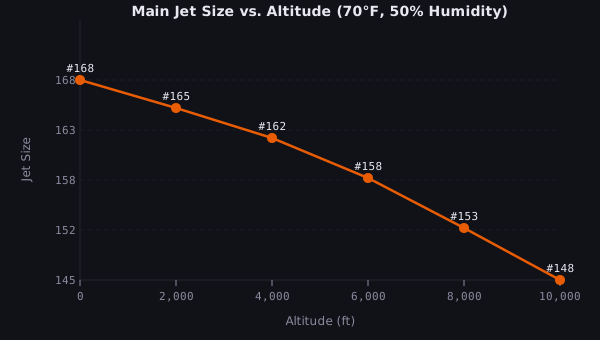
Why Altitude Forces a Rejet
If you've ever ridden a trail at sea level and then trailered your bike to an 8,000-foot mountain ride, you already know the feeling. The bike bogs off idle, loses punch in the mid-range, and feels half-dead by the time you're in the high country. That's not your imagination. The air up there is genuinely thinner, and your carburetor is still metered for the denser stuff down below.
To rejet carburetor for altitude, you're correcting for one hard fact: less oxygen per cubic foot of air means your existing jet is flowing too much fuel relative to the available air. The mixture goes rich. Power drops. Black sooty plugs follow.
This isn't a minor tune. A 7,500-foot elevation gain typically requires dropping 3 to 5 main jet sizes. That's a meaningful change that affects how your engine breathes all the way through the RPM range.
What You'll Need Before You Start
Gather these before you pull the carb:
- Jet kit or assortment (main jets, pilot jets in 2-size steps)
- Flat-head and Phillips screwdrivers
- 8mm and 10mm sockets
- Needle-nose pliers
- Fresh spark plug (optional but smart)
- Shop rags and a clean tray for parts
- A known-good baseline: write down your current jet sizes before touching anything
If you don't know what's currently in your carb, pull it and check before you do anything else. Rejetting from an unknown baseline is guesswork.
The WR250F Example: From 500 Feet to 8,000 Feet
Here's a real-world walk-through using a Yamaha WR250F with a Keihin FCR carburetor, stock jetting for riding near sea level.
Baseline setup (500 ft, 65°F):
- Main jet: 165
- Pilot jet: 42
- Needle: OBDVS clip position 3 (middle)
- Air screw: 1.75 turns out
The rider is heading to a trail system that sits between 7,500 and 9,000 feet. Average riding elevation: roughly 8,000 feet. Temperature up there runs around 55°F in the morning, 72°F midday.
Step 1: Calculate the density change.
The rule of thumb is roughly 3% less air density per 1,000 feet of elevation gain. From 500 feet to 8,000 feet, that's a 7,500-foot rise, about 22% less dense air. However, the cooler temperature at altitude partially offsets that (cooler air is denser), so the effective correction lands closer to 18-19%.
Run those numbers through our jetting calculator and you get a recommended main jet of approximately 155, a 10-point drop from the 165.
Step 2: Adjust pilot circuit.
The pilot jet handles idle through roughly 1/4 throttle. A 42 pilot at sea level typically drops to a 38 at 8,000 feet. Some riders go to a 40 and accept slightly rich low-end behavior; it's safer on the engine than running lean.
Step 3: Move the needle.
Drop the needle clip one position (from position 3 to position 2). This leans the mid-throttle range; the needle governs fuel delivery from about 1/4 to 3/4 throttle, which is where you spend most of your trail riding time.
Step 4: Air screw adjustment.
Richen the air screw slightly from 1.75 turns to 2.0 turns out. This seems counterintuitive when you're trying to lean out, but the air screw on a Keihin FCR controls the fuel-air mix at idle, and the pilot jet change already did the heavy lifting.
Final high-altitude setup:
- Main jet: 155
- Pilot jet: 38
- Needle: OBDVS clip position 2
- Air screw: 2.0 turns out
Step-by-Step Removal and Jetting Process
1. Let the engine cool completely. Carburetors sit between the airbox and cylinder head. Working on a hot engine is both painful and increases the chance you'll strip a jet with a screwdriver that slips.
2. Turn fuel petcock to OFF.
3. Remove the airbox or disconnect the intake boot. On most dirt bikes, three or four bolts hold the airbox in place. Pull the boot clamp and work the carb free from the boot.
4. Disconnect the throttle cables. On FCR carbs there are two: one to open, one to close. Note which cable connects where. Take a photo if you need to.
5. Remove the float bowl. Four small screws on the bottom. Have a rag ready; residual fuel will drip out.
6. Unscrew the main jet. It sits in the center of the float bowl cavity. It's a brass hex fitting. Use a proper flat-head screwdriver that fully seats in the slot. A loose fit will round out the jet. Mark the old jet size on masking tape before setting it aside.
7. Swap in the new main jet. Snug it down firmly but don't gorilla it. Brass threads strip easily.
8. Pull the needle. This requires removing the top cap and slide. The needle is held by a small circlip. Move it one groove toward the blunt end (top) to raise the clip position number, which lowers the needle and leans the mid-range.
9. Swap pilot jet. Located adjacent to the main jet, smaller diameter. Same process.
10. Reassemble in reverse order. Don't forget to re-open the petcock.
How to Test Your New Jetting
Start the bike cold and let it warm up fully, at least 3 to 5 minutes at the new altitude. Then ride a controlled test:
- Idle quality: Should be smooth and consistent without hanging RPM
- Off-idle snap: Blip the throttle. Should respond crisply with no bog or hesitation
- 1/4 to 1/2 throttle roll-on: Steady acceleration, no stumble
- Full-throttle pull: Strong, clean, no four-stroking or blubber sound
Pull the spark plug after a 15-minute ride that includes some full-throttle sections. A correct tune shows a tan or light coffee-colored electrode. White or light grey means lean. Black and oily means rich.
If you're rich after these changes, drop the main jet one more size (e.g., from 155 to 152) and repeat the plug check. If you're lean, go up one size. Fine-tuning by 2-3 jet sizes around the calculated recommendation is normal.
Jetting Charts vs. Calculators
Jetting charts (the paper ones packed inside jet kits) give you ballpark starting points, but they assume standard temperature at each elevation and don't account for your specific bike's state of tune, exhaust, or air filter. A calculator that takes actual temperature and altitude together gives a more accurate first guess.
Try the calculator to get your specific starting point before you start pulling jets. You'll waste fewer jets and less time on the trail test loop.
For background on how density altitude math actually works, which is what drives the jetting correction, read our post on density altitude explained. Understanding that concept makes it clear why two rides at "the same elevation" can require different jetting depending on weather.
And once you've made your change, if the bike still feels off, check out our breakdown of rich vs. lean jetting symptoms to diagnose what the engine is telling you before you pull jets again.
Related Articles
Rich vs. Lean Jetting: Read Your Engine's Warning Signs
Identify rich vs lean jetting symptoms fast. Black plugs, backfiring, overheating. Here's what your …
automotiveDensity Altitude Explained: Why Power Drops at Elevation
Density altitude determines how thin the air really is. Learn how pressure, temperature, and humidit…
Free Tool
Carburetor Jet Size Calculator
Calculate the correct carburetor jet size based on altitude, temperature, and engine modifications for optimal air-fuel ratio tuning.
Use the Calculator →CarburetorJet.com Team
Powersports enthusiasts and engine tuning specialists with 15+ years of carburetor tuning experience across motorcycles, ATVs, and karts.