Rich vs. Lean Jetting: Read Your Engine's Warning Signs
Identify rich vs lean jetting symptoms fast. Black plugs, backfiring, overheating. Here's what your engine is telling you and how to fix it.
Your Engine Is Already Telling You Something
Rich vs. lean jetting symptoms show up before any expensive damage happens, if you know what to look for. The carburetor is a mechanical air-fuel mixer, and when that mix goes wrong in either direction, your engine communicates clearly through sound, feel, smoke, and spark plug color.
Most riders guess wrong on the first diagnosis. A bog off idle gets blamed on a lean condition when it's actually a rich pilot circuit. Popping on deceleration gets blamed on lean when it's sometimes a symptom of an air leak. Below you'll find specific, observable signs tied to specific throttle positions, so your next diagnosis is based on evidence rather than guesswork.
Rich Jetting: Too Much Fuel, Not Enough Air
A rich mixture means your carburetor is delivering more fuel than the incoming air can burn cleanly. The combustion chamber gets flooded with unburned fuel, which shows up in several ways.
Symptoms of a rich condition:
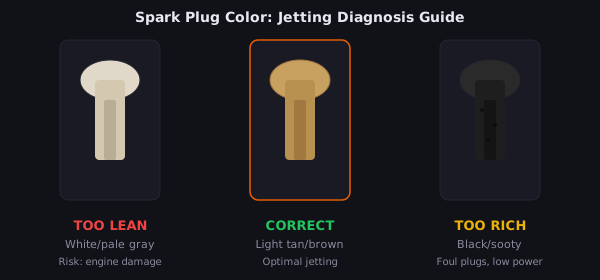
- Black, sooty spark plug. This is the clearest single indicator. Pull your plug after a 15-minute ride that included some full-throttle runs. A plug that's black and powdery, or black and oily, points to excessive fuel.
- Black smoke from the exhaust. Particularly visible on acceleration. Light grey is normal. Black is rich.
- Bog or hesitation on initial throttle. The engine stumbles when you crack the throttle quickly. This is especially common with an over-rich pilot jet affecting the 0 to 1/4 throttle range.
- Four-stroking at full throttle. That blubby, loping sound at WFO where the engine sounds like it's hitting on every other stroke. The excess fuel is quenching combustion.
- Poor fuel economy. You're burning more than you should, but it's hard to notice on short rides.
- Hard hot starts. Rich engines flood easily when hot. Too much fuel, engine already warm, and it won't fire cleanly.
Rich conditions are harder on your exhaust system than your engine internals. But left uncorrected, oil dilution from fuel washing the cylinder walls is a real long-term concern.
Lean Jetting: Too Little Fuel, Too Much Air
A lean mixture burns hotter and faster. There's not enough fuel to absorb combustion heat, so temperatures spike. This is where things get dangerous if you ignore it.
Symptoms of a lean condition:
- White or light grey spark plug. A pale, almost white electrode and insulator means the mixture is burning too hot and too clean. Normal is a tan to light brown color.
- Popping or backfiring on deceleration. When you shut the throttle, unburned oxygen in the exhaust ignites from residual heat. This is almost always lean pilot circuit territory.
- Overheating. The engine runs hotter than normal. You'll feel it radiating from the cases, and liquid-cooled bikes will show elevated coolant temps.
- Pinging or detonation under load. A sharp metallic knock on hard acceleration. Lean + high load = pre-ignition risk. Stop riding and fix it.
- Snappy, aggressive throttle response that fades. Initial response feels crisp but power drops off quickly under sustained load.
- Seizure risk. A lean two-stroke will seize. A lean four-stroke will burn a valve or piston. Don't ignore lean symptoms.
Throttle Position Tells You Which Circuit to Blame
This is the most useful diagnostic framework, and most riders skip it entirely.
The carburetor has multiple fuel circuits, and each one governs a specific throttle range:
| Throttle Range | Governing Circuit |
|---|---|
| Idle / closed | Pilot jet + air screw |
| 0 to 1/4 open | Pilot jet primarily |
| 1/4 to 3/4 open | Needle position |
| 3/4 to full open | Main jet |
So if your problem only shows up at full throttle (four-stroking, lean ping, white plug), the main jet is the culprit. If your problem is idle quality and off-idle response, look at your pilot jet and air screw first. Don't swap your main jet because your idle is rough. That's a waste of time and jets.
A Real Example: What Happens When Conditions Change
Here's a concrete illustration of how a correctly-jetted bike can go rich without any hardware changes.
Say you have a bike jetted at sea level in 70°F weather with a 170 main jet. That setup is dialed in: tan plug, crisp throttle response, strong pull to redline.
Now you ride that same bike at 5,000 feet elevation on a hot 90°F summer day. What's the effective air density change?
- Elevation effect: 5,000 ft × 3% per 1,000 ft = approximately 15% less air density
- Temperature correction: going from 70°F (standard) to 90°F adds roughly another 3-4% reduction in density
Combined, you're looking at roughly 18% less oxygen reaching the combustion chamber. But you're still flowing fuel through a 170 jet sized for 100% density air. That 170 is now effectively acting like a 170 × 1.18 = roughly a 200-equivalent jet in terms of fuel-to-air ratio.
That's massively rich. You'd need to drop to somewhere around a 142 to 145 main jet to restore proper mixture. Use the carb jet size tool to get the precise recommendation for your exact elevation and temperature combination.
The Plug Chop: Your Most Reliable Diagnostic
A plug chop is the gold standard for reading main jet mixture. Here's the procedure:
- Start with a fresh, new spark plug.
- Ride at full throttle for at least 30 seconds, long enough for steady-state combustion.
- Kill the engine mid-run (don't let it return to idle; that contaminates the reading).
- Pull the clutch, coast to a stop.
- Remove and examine the plug immediately.
Reading the plug:
- Tan to light coffee: Perfect.
- White or very light grey: Lean. Go up 1-2 jet sizes.
- Dark brown to black and dry: Rich. Go down 1-2 jet sizes.
- Black and oily: Very rich, or oil fouling from a different issue.
Do the plug chop after any jetting change, and after any significant elevation or temperature change. It's free information that takes 10 minutes to collect.
Diagnosing vs. Chasing Symptoms
One common mistake: making multiple changes at once. If you swap the main jet, pilot jet, and move the needle clip all in one session and the bike runs better, you don't know which change helped. Make one change, test it, then make another.
Also rule out non-jetting causes before you start swapping jets. A clogged air filter mimics rich conditions (restricted air). An air leak at the intake boot mimics lean conditions (extra unmetered air). A stuck float needle causes a consistent rich condition at all throttle positions. These are mechanical fixes, not jetting fixes.
Once you've confirmed the bike is mechanically sound and the symptoms match a specific throttle range, you can confidently reach for the jet kit.
For riders heading to different elevations, check out our full guide on how to rejet your carburetor for altitude, which walks through a complete before/after jetting example with real numbers.
And if your symptoms change with the seasons rather than elevation, the seasonal jetting guide covers exactly how temperature swings between summer and winter shift your optimal jet sizes.
Related Articles
How to Rejet Your Carburetor for High Altitude
Learn how to rejet carburetor altitude changes step by step. Includes a real WR250F example going fr…
automotiveSeasonal Jetting Guide: Tune Your Carb Year-Round
Seasonal jetting changes keep your carb dialed in summer and winter. Learn exact jet size shifts by …
Free Tool
Carburetor Jet Size Calculator
Calculate the correct carburetor jet size based on altitude, temperature, and engine modifications for optimal air-fuel ratio tuning.
Use the Calculator →CarburetorJet.com Team
Powersports enthusiasts and engine tuning specialists with 15+ years of carburetor tuning experience across motorcycles, ATVs, and karts.