Seasonal Jetting Guide: Tune Your Carb Year-Round
Seasonal jetting changes keep your carb dialed in summer and winter. Learn exact jet size shifts by season, cold-start tips, and when to retune your carburetor.
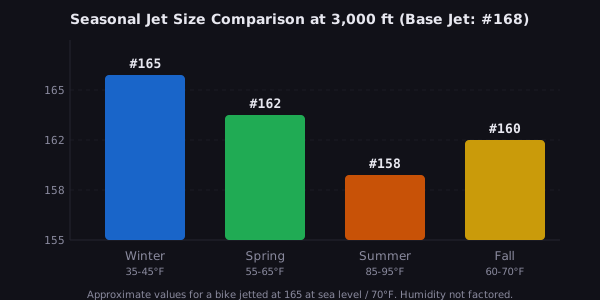
Why the Calendar Affects Your Carburetor
Seasonal jetting isn't something most riders think about until the bike starts acting up. You didn't change anything (same trail, same carburetor, same air filter), but the bike feels flat in August or bogs in December. The difference is air.
Cold air is denser than warm air. Denser air holds more oxygen per cubic foot. More oxygen means your existing fuel delivery is proportionally leaner relative to the available air charge. Flip that around for summer: hot air is thin, your fuel delivery becomes relatively rich compared to what the engine can burn.
If you're running a fixed main jet (which is every carbureted bike that hasn't been rejetted), your air/fuel ratio shifts with the seasons even if you never touch the carb. The question is just how much, and whether it's enough to matter.
For most riders at low elevation with moderate seasonal temperature swings (say, 40°F to 80°F), the seasonal effect is real but minor, maybe 2 to 3 jet sizes. For riders in climates with big swings (20°F winters, 100°F summers) or those riding at elevation, the difference can be 5 to 8 jet sizes. That's enough to noticeably affect power, plug condition, and engine longevity.
The Spring-to-Summer Example: Same Trail, Different Tune
Here's a concrete example. Take a KTM 450 EXC-F with a Keihin FCR 39 carburetor, set up for a mountain trail that runs between 4,000 and 6,000 feet elevation.
Spring ride, late April, 45°F at the trailhead, 4,500 ft average elevation:
Using the density altitude model, 45°F at 4,500 feet is actually below ISA standard temperature at that altitude (ISA would predict about 44°F there, so conditions are nearly standard). The air is fairly dense for the elevation.
Starting point: main jet 162, pilot jet 40, needle clip position 3.
Summer ride, same trail, same elevation, mid-July, 90°F at the trailhead:
Temperature at 4,500 feet in July: approximately 90°F.
ISA temperature at 4,500 feet: approximately 44°F.
Temperature deviation above ISA: 46°F = approximately 25.5°C.
Density altitude calculation:
4,500 + (120 × 25.5) = 4,500 + 3,060 = 7,560 feet effective density altitude
That's a 3,060-foot jump in effective density altitude from the same physical trail. Running the numbers through our jetting calculator, the summer main jet recommendation drops to approximately 152, a 10-point reduction from the spring setup.
The pilot jet drops from 40 to 38, and the needle clip moves from position 3 to position 2 (leaning the mid-range).
That's a meaningful difference. The bike jetted for spring will run noticeably rich on the July ride: four-stroking at full throttle, black plug, reduced peak power.
Summer Jetting: Going Leaner
Summer jetting corrections go in one direction: leaner. Hot air carries less oxygen, which means you need less fuel to maintain the correct ratio.
Typical summer adjustments (sea level to 3,000 ft, 85–100°F):
- Main jet: down 3 to 5 sizes (e.g., 168 → 162 or 160)
- Pilot jet: down 1 size (e.g., 42 → 40)
- Needle clip: up 1 position (lean the mid-range)
- Air screw: typically no change, or 1/4 turn richer to compensate for lean pilot
At elevation in summer heat (3,000–7,000 ft, 85–100°F):
- Main jet: down 6 to 10 sizes from sea-level cold-weather baseline
- Pilot jet: down 1 to 2 sizes
- Needle clip: up 1 to 2 positions
Humidity adds to the summer effect. High humidity (80%+) in lowland environments can shift effective density altitude by an additional 500 to 1,000 feet. On humid summer days, bias your jetting slightly leaner than the temperature-alone calculation suggests.
Winter Jetting: Going Richer
Cold, dense winter air is an engine's friend from a combustion standpoint. More oxygen per intake stroke means more potential power, but only if you give the engine more fuel to match.
A bike jetted for summer will run lean in winter. Lean in cold weather means rough idle, popping on deceleration, and reduced power despite the theoretically better air charge.
Typical winter adjustments (sea level to 3,000 ft, 20–45°F):
- Main jet: up 3 to 6 sizes (e.g., 162 → 168 or 170)
- Pilot jet: up 1 size (e.g., 40 → 42)
- Needle clip: down 1 position (richen the mid-range)
- Air screw: 1/4 to 1/2 turn leaner (out) to balance the richer pilot jet
At lower temperatures, your choke or cold-start enrichment circuit also plays a larger role. A bike that fires up fine at 70°F with no choke will need full choke for 3 to 5 minutes at 25°F before the pilot circuit warms up enough to idle without it.
Cold-Start Jetting vs. Ride Jetting
There's an important distinction here that trips up a lot of riders: cold-start behavior is governed by the pilot circuit and choke enrichment, not the main jet. If your bike starts hard in cold weather, the main jet size is almost certainly not the issue.
Cold-start problems are usually:
- Pilot jet too lean for cold-air conditions (go up 1 size)
- Air screw adjusted too lean (turn in 1/4 turn)
- Choke circuit not fully closing (mechanical issue)
- Fuel thickened by cold temperatures sitting in the bowl
Once the engine is warm and you're riding, the main jet takes over at 3/4 to full throttle. Pilot circuit behavior at full operating temp is different from cold behavior. Don't confuse hard starting in cold weather with a main jet jetting problem.
Reading Seasonal Symptoms
The symptoms of incorrect seasonal jetting look exactly like standard jetting problems, because they are the same problem, just caused by air density rather than hardware changes.
Rich symptoms in summer (bike jetted too fat for hot conditions):
- Four-stroking or blubbing at full throttle on hot days
- Black, sooty spark plug after a summer ride
- Reduced top-end power compared to spring or fall
Lean symptoms in winter (bike jetted too thin for cold conditions):
- Popping and backfire on deceleration in cold weather
- Rough idle that clears up after 10+ minutes of warm-up
- Slightly better-than-expected top-end pull (lean bikes feel crisp until they overheat, though overheating is rarely a concern in cold weather)
For a full breakdown of what each symptom means and which circuit to target, see our post on rich vs. lean jetting symptoms. It covers the throttle-position diagnostic framework that tells you whether you're looking at a pilot, needle, or main jet issue.
Practical Seasonal Jetting Strategy
You don't have to carry six jet sizes in your tool bag. A practical approach:
Two-setup system:
Set up a "summer kit" and a "winter kit." Write both configurations on a card and tape it inside your seat or airbox. When seasons change, swap to the other setup. Each swap takes about 20 minutes.
Three-season tracking:
- Winter (below 45°F): richest setup
- Spring/fall (45°F–70°F): middle setup (often factory baseline)
- Summer (above 70°F): leanest setup
Elevation modifier:
Add the elevation correction on top of the temperature correction. If you normally ride at 4,000 feet in summer, your effective density altitude might be 6,500 to 7,500 feet. Use the carb jet size tool to combine both variables into a single jet recommendation rather than trying to calculate each independently.
Seasonal Maintenance to Do Alongside Jetting
When you're already inside the carb for a seasonal rejet, it's worth doing a few other things:
- Inspect the float for leaks or saturation (shake it; if you hear fuel inside, replace it)
- Clean the pilot jet orifice with compressed air (never a wire; that will enlarge the orifice)
- Check the needle for wear grooves at the clip position
- Inspect the accelerator pump diaphragm for cracks (common on bikes stored over winter)
- Drain and replace float bowl fuel if the bike sat for more than 30 days
Stale fuel left in the float bowl over winter gums up pilot jets and causes the kind of idle problems that get misdiagnosed as jetting issues all spring. A carb cleaner soak fixes what looks like a jetting problem but is actually a maintenance problem.
For the altitude side of jetting, specifically when you're riding significantly above your home elevation, our guide on how to rejet your carburetor for altitude walks through a complete before/after example with real jet numbers and the full procedure.
Seasonal tuning takes a little more discipline than set-it-and-forget-it jetting, but the payoff is a bike that feels right year-round instead of only during the weeks when the weather matches the conditions it was jetted for.
Related Articles
Rich vs. Lean Jetting: Read Your Engine's Warning Signs
Identify rich vs lean jetting symptoms fast. Black plugs, backfiring, overheating. Here's what your …
automotiveHow to Rejet Your Carburetor for High Altitude
Learn how to rejet carburetor altitude changes step by step. Includes a real WR250F example going fr…
Free Tool
Carburetor Jet Size Calculator
Calculate the correct carburetor jet size based on altitude, temperature, and engine modifications for optimal air-fuel ratio tuning.
Use the Calculator →CarburetorJet.com Team
Powersports enthusiasts and engine tuning specialists with 15+ years of carburetor tuning experience across motorcycles, ATVs, and karts.