Keihin vs. Mikuni Jets: Which Fits Your Carb?
Keihin vs Mikuni jets look similar but are NOT interchangeable. Learn sizing systems, which bikes use which brand, and how to identify your carburetor.
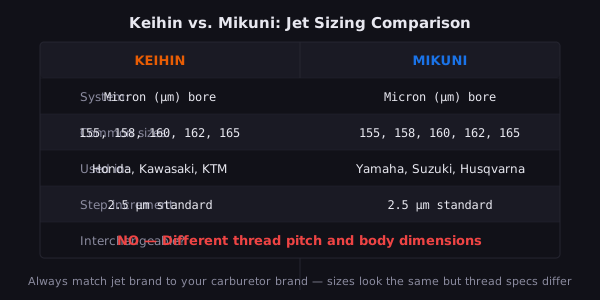
Two Brands, Two Different Jets
If you've ever ordered a jet pack online and received something that looked right but wouldn't thread in, you already know the problem. Keihin vs Mikuni jets are the two dominant brands in powersports carburetors, and while they share the same numbering philosophy, they do not share the same thread pitch, body diameter, or internal geometry. Mixing them up wastes money and can damage your carburetor.
Here's how to identify which brand is in your bike, how each sizing system works, which carb models you're likely dealing with, and where to source the right jets without burning a weekend on the wrong order.
How Jet Numbering Works (Both Brands)
Both Keihin and Mikuni use a numbering system based on the jet's flow orifice size in hundredths of a millimeter. A "175" main jet has a 1.75mm orifice. A "42" pilot jet has a 0.42mm orifice.
That's where the similarities end.
The physical jet body (its outer diameter, thread pitch, hex size, and length) is specific to the carburetor model it was designed for. A Keihin FCR main jet has a different thread than a Mikuni TMX main jet, even if both are labeled "168." You can't force one into the other without stripping threads.
Aftermarket jet kits from companies like Dynojet are designed specifically for one carburetor model or brand family. Always buy jets specified for your exact carb, not just your engine displacement.
Which Bikes Use Keihin vs. Mikuni
The carburetor brand on your bike is determined by the manufacturer's OEM choice for that model year. Here's the general breakdown:
Keihin-equipped bikes (common examples):
- Honda: virtually all off-road and street models (CRF, XR, CBR series), where Keihin has been the OEM choice for decades
- Kawasaki: most motocross and dual-sport models (KX, KLX)
- Yamaha WR/YZ four-strokes: switched from Mikuni to Keihin FCR in the late 1990s
- Many ATVs from Honda and Kawasaki
Mikuni-equipped bikes (common examples):
- Yamaha: most street bikes (R1, R6, V-Star, XT series) and older YZ two-strokes use Mikuni
- Suzuki: majority of both street and off-road models (DR, RM, GSX-R)
- KTM older models: many used Mikuni before switching to Keihin and later to fuel injection
- Polaris ATVs and some Arctic Cat snowmobiles
The honest answer is that you need to check your specific model year. Even within a single model line, manufacturers switched brands. A 1998 YZ250 uses a Keihin PWK. A 2003 YZ250F uses a Keihin FCR. A 1996 DR350 uses a Mikuni BST.
Identifying Your Carburetor
You don't have to guess. The carburetor body itself is stamped or cast with the brand name and model code.
Look for a casting mark or raised lettering on the main carb body (not the float bowl). It'll say "KEIHIN" or "MIKUNI" and then a model code like "FCR 39" or "TMX 38." The number in the model code is the carb's bore diameter in millimeters.
Common Keihin models you'll encounter:
- FCR: flat-slide, used on most modern four-stroke dirt bikes and dual-sports. High-performance, very tuneable.
- PWK: flat-slide, widely used on two-stroke motocross bikes (CR125, KX125/250)
- CVK: constant-velocity (CV) slide, common on Honda street bikes and ATVs
Common Mikuni models:
- TMX: flat-slide, two-stroke motocross (RM125/250, older YZ two-strokes)
- TM: flat-slide, used on various Suzuki and Yamaha models
- BST: constant-velocity (CV), used on Suzuki street and dual-sport bikes
- HSR: high-performance CV, popular on Harley-Davidson applications with aftermarket upgrades
- VM: round-slide, older bikes and small engines
Jet Types Within Each Brand
Both brands produce multiple jet types, and they're not interchangeable even within the same brand.
Keihin jet types:
- Main jet (hex body, straight orifice)
- Pilot/slow jet (smaller, different thread pitch than main)
- Needle jet (the brass tube the needle slides through, often overlooked)
- Starter jet (for choke circuit)
Mikuni jet types:
- Main jet (two sub-types: "round" body and "hex" body, different thread pitches)
- Pilot jet
- Jet needle and needle jet
- Starter jet
Mikuni round-body main jets are used in VM and older TM carbs. Mikuni hex main jets are used in TMX and newer TM carbs. Order the wrong subtype and it won't fit, even though it's the same brand.
Interchangeability: The Short Answer
Jets from Keihin carburetors will not fit Mikuni carburetors. Jets from Mikuni carburetors will not fit Keihin carburetors. Jets from a Keihin FCR will not fit a Keihin CVK. Jets from a Mikuni TMX will not fit a Mikuni BST.
The jet numbering (like 165, 42, etc.) tells you the orifice size; it does not tell you the physical fitment. Always spec jets by carburetor model, not just by jet number.
There is one partial exception: some aftermarket jets marketed as "universal" use Mikuni-compatible threading and may fit a range of Mikuni carbs. These can work in a pinch but aren't a substitute for OEM-spec jets when you need precise calibration.
A Practical Sizing Example
Say you're running a Suzuki RM250 with a Mikuni TMX 38 carburetor, stock jetting for a sea-level track. The main jet is a 340, pilot jet is a 40.
You're heading to a race at 4,500 feet. Using our jetting calculator, you get a recommended main jet of approximately 320, a 20-point drop. You need a Mikuni hex main jet in size 320 for the TMX series.
Don't reach for a Keihin jet because the shop has them in stock. A Keihin 320 will have a different thread pitch, probably M5×0.75 vs. the Mikuni's M6×0.75 or similar, and forcing it in will strip the emulsion tube.
Order from a Mikuni dealer, a Dynojet kit for the TMX, or check Rocky Mountain ATV or similar mail-order parts houses that stock jets by carb model. Mikuni's own website (Mikuni American) has a fitment guide.
How to Confirm Your Jet Size Before Ordering
Before you order, pull your existing jets and measure or read the stamped number directly. Use a magnifying glass; the numbers on pilot jets especially can be tiny.
If you can't read the stamp, a set of numbered drill bits can give you the approximate orifice diameter. A 1.65mm drill (close to a size 165 Keihin jet) sliding freely through a jet confirms the approximate size. This isn't precise enough for tuning purposes but it'll tell you the ballpark.
Record your current jet sizes in writing before you go on any trip where you'll be rejetting. Carb tuning in a trailhead parking lot is much easier when you know where you started.
For the altitude correction math that determines what size you need, try the calculator since it handles both elevation and temperature adjustments together. For a deeper look at the atmospheric science behind why elevation changes jetting, read our post on density altitude explained.
And once you've ordered and installed new jets, use our guide on how to rejet your carburetor for altitude for the full installation and testing process.
Related Articles
How to Rejet Your Carburetor for High Altitude
Learn how to rejet carburetor altitude changes step by step. Includes a real WR250F example going fr…
automotiveDensity Altitude Explained: Why Power Drops at Elevation
Density altitude determines how thin the air really is. Learn how pressure, temperature, and humidit…
Free Tool
Carburetor Jet Size Calculator
Calculate the correct carburetor jet size based on altitude, temperature, and engine modifications for optimal air-fuel ratio tuning.
Use the Calculator →CarburetorJet.com Team
Powersports enthusiasts and engine tuning specialists with 15+ years of carburetor tuning experience across motorcycles, ATVs, and karts.