Pilot Jet vs. Main Jet: When to Adjust Each
Pilot jet vs main jet confusion causes most jetting failures. Learn which throttle ranges each controls, when to adjust them, and how altitude affects both.
Two Jets, Two Jobs
The pilot jet vs main jet question trips up riders constantly, and understandably so. Both are fuel metering components, both affect how the bike runs, but they control completely different throttle ranges. Mixing up which one to adjust wastes time and money.
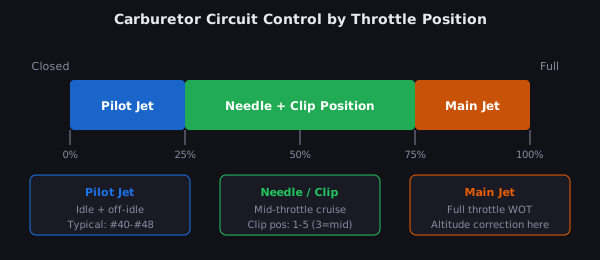
Here's the simple breakdown before we get into the details: the pilot jet controls fuel delivery at idle through roughly 1/4 throttle. The main jet takes over from about 3/4 throttle to wide open. The needle (a tapered pin in the slide) bridges the transition from 1/4 to 3/4. If you're only swapping jets, you're addressing the two endpoints of the throttle range.
Understanding this split is what separates a tuner who gets results from one who keeps buying jets and never fixes the real problem.
The Throttle Position Map
Let's put exact numbers to it:
- 0 to 1/4 throttle: Pilot jet is the primary fuel source. Also called the slow jet on some Mikuni carbs. This range covers idle, low-speed trail riding, and parking lot speeds.
- 1/4 to 3/4 throttle: Needle clip position dominates. The needle's taper controls how much fuel enters as the slide lifts. This is where most trail riding happens.
- 3/4 to WOT (wide-open throttle): Main jet takes over. At full throttle, the needle is fully lifted and the main jet's bore diameter is the limiting factor for fuel flow.
These ranges aren't hard cutoffs; they blend into each other. But when a rider says "the bike bogs just off idle," that's a pilot circuit issue. When it signs off at full throttle on a long straight, that's the main jet.
How to Diagnose Which Circuit Is the Problem
The symptom location on the throttle tells you which jet to reach for.
Pilot circuit symptoms:
- Hard to start cold or hot
- Rough idle or won't hold idle
- Stumble or hesitation at very low throttle openings
- Popping and backfiring on deceleration (typically too lean in the pilot circuit)
Main jet symptoms:
- Loss of top-end power
- Power feels flat or cuts out at wide-open throttle
- Plug reading shows lean or rich at WOT (white or black, respectively)
- Overheating at sustained full throttle
If symptoms show up in both ranges, the baseline fuel screw setting may be off, or there's a bigger issue like an air leak.
When Altitude Changes Affect Each Jet
Altitude affects both circuits, but not equally, and not always at the same time.
The main jet typically needs correction first. At 5,000 feet versus sea level, air density drops roughly 16%. The fuel-to-air ratio shifts lean, and the main jet is the primary culprit for full-throttle lean conditions. This is the correction most altitude jetting guides focus on.
The pilot jet is less sensitive to altitude changes in mild cases. For a climb of 2,000-3,000 feet, many riders can leave the pilot alone and just correct the main. But once you're moving more than 4,000-5,000 feet of elevation, the pilot circuit leans out enough to notice, especially at low throttle openings.
A Real Scenario: 500 ft to 6,000 ft
Here's a concrete example. A 2020 Yamaha WR250F running stock jetting: 45 pilot jet, 168 main jet, riding at 500 feet.
The rider travels to a Colorado trail at 6,000 feet. That's a 5,500-foot elevation gain.
Main jet correction:
Going from 500 ft to 6,000 ft represents roughly a 16-17% drop in air density. The main jet needs to drop proportionally. Starting from 168, a 6% correction for the first 5,000 feet of elevation puts you at 158 (168 × 0.94 = 157.9, round to 158). The remaining 500-foot gain is minor, so stay at 158 and verify with a plug chop.
Plug those numbers into the calculator to get a precise recommendation based on temperature and elevation together.
Pilot jet correction:
At 6,000 feet, a lean pilot is possible. The 45 pilot may hold at this elevation, or you may need to drop to a 42 depending on how the bike responds off idle. If it idles cleanly and transitions without stumbling, the 45 is fine. If there's deceleration popping or a hesitation right off idle, swap to a 42.
The rule of thumb: if the main jet change is 5 or more sizes, check the pilot. If it's under 5, you can usually leave the pilot alone and adjust the fuel screw instead.
Sizing Conventions
Pilot and main jets are sized by fuel flow in cc/min, but the number conventions differ between brands and can be confusing.
Keihin (Honda, Kawasaki, many others): Pilot jets run roughly 35-55 for most 250-450cc bikes. Main jets typically range from 95 to 200, depending on displacement and state of tune. Numbers go up as the jet gets richer.
Mikuni (Yamaha, Suzuki, some aftermarkets): Uses a similar number convention, but the jets themselves are NOT interchangeable with Keihin. A Mikuni 168 main jet and a Keihin 168 main jet have different thread sizes and flow rates. Using the wrong brand's jet in your carb is a mistake that will throw your tune completely off. See our detailed comparison of Keihin vs Mikuni jets.
Common Pilot Jet Sizes by Bike Type
To give you a sense of scale:
- 125cc two-strokes: Pilot jets typically range from 25-40
- 250cc four-strokes: Usually 35-45
- 450cc four-strokes: Typically 42-52
- 650cc+ singles (like the DR650): Often 42-48
These are starting points, not gospel. Elevation, temperature, and modifications all shift the target.
When to Leave the Pilot Alone
Not every jetting session needs a pilot jet change. If the bike starts well, idles smoothly, and transitions off idle cleanly, the pilot circuit is working. Don't chase a fix that isn't broken.
The fuel screw (accessible from the bottom of most carbs without removing the carb) is the fine-tuning tool for the pilot circuit. Turning it out (counterclockwise) richens; turning it in (clockwise) leans. The ideal range is typically 1.5 to 2.5 turns out from fully seated. If you need more than 3 turns out, go up a pilot jet size. If fully seating the screw makes little difference, go down a size.
Putting It Together
When you're dialing in jetting, whether it's for altitude, a new exhaust, or just getting a used bike right, work the circuits in order:
- Start with the main jet (WOT feel and plug color)
- Address the needle clip position if mid-range is off
- Check pilot last; adjust fuel screw first, change the jet if the screw can't compensate
That sequence catches the most obvious issues first. Going straight to the pilot jet when the main is way off wastes time and can create misleading symptoms.
For altitude and temperature corrections, try the carb jet size tool to get a baseline before you start pulling jets. Then pair that with an understanding of which circuit is throwing the symptoms, and you'll get to the right tune in one or two iterations instead of six.
Also worth reading: if you're adding an aftermarket exhaust to the equation, the aftermarket exhaust jetting guide walks through how to stack those corrections on top of the altitude adjustment.
Related Articles
How to Rejet Your Carburetor for High Altitude
Learn how to rejet carburetor altitude changes step by step. Includes a real WR250F example going fr…
automotiveAftermarket Exhaust and Jetting: What Size Jet Do You Need?
Upgrading your exhaust changes your jetting needs. Learn how aftermarket exhaust jetting works, what…
Free Tool
Carburetor Jet Size Calculator
Calculate the correct carburetor jet size based on altitude, temperature, and engine modifications for optimal air-fuel ratio tuning.
Use the Calculator →CarburetorJet.com Team
Powersports enthusiasts and engine tuning specialists with 15+ years of carburetor tuning experience across motorcycles, ATVs, and karts.