7 Carburetor Jetting Mistakes That Wreck Your Tune
Carburetor jetting mistakes cost you performance and can damage your engine. Here are the 7 most common errors riders make, and how to avoid each one.
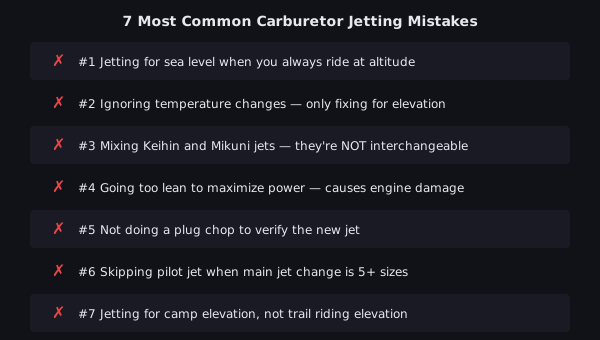
What Bad Jetting Actually Costs You
Carburetor jetting mistakes fall into two categories: the ones that hurt performance and the ones that hurt your engine. The frustrating part is that most riders don't know they've made them until something goes wrong: either a flat powerband that won't respond to changes, or worse, a scored piston.
These 7 mistakes account for the majority of jetting failures I've seen. Most of them are fixable in an afternoon once you know what you're looking at.
Mistake 1: Jetting for Sea Level When You Ride at Altitude
This is the most common jetting mistake, and it's especially dangerous because lean jetting feels like a power improvement initially. The throttle response seems crisper. The bike revs faster. Then combustion temps climb, and things go wrong.
Air density at 5,000 feet is roughly 16% lower than at sea level. Your carburetor delivers the same amount of fuel regardless, but now there's 16% less air to mix it with. That combination should make the bike run rich at altitude. But factory jetting is often calibrated lean from the factory (for emissions compliance), so the net effect can still be a lean or neutral condition rather than rich.
The fix is to go down in main jet size for altitude. A bike running a 168 main at sea level should be closer to a 140-145 main at 5,000 feet. Use the jetting calculator to get a precise starting point for your elevation and temperature combination.
Don't assume your stock jetting is correct just because it left the factory that way. Many bikes are jetted lean from the factory.
Mistake 2: Forgetting Temperature When You Change Altitude
Altitude and temperature both affect air density, and they don't always move in the same direction. You can go up in elevation (less dense air, want leaner jetting) while also experiencing colder temperatures (denser air, want richer jetting). The two effects partially cancel each other out.
Riders who only correct for altitude and ignore temperature can end up over-correcting. Here's a real example: going from sea level at 95°F to 7,000 feet at 45°F. Altitude alone says go down 5-6 jet sizes. Temperature drop says go back up 2-3 sizes. Net correction: 3 sizes down, not 6.
This is exactly what density altitude captures. Density altitude accounts for both elevation and temperature together. At FAA.gov, you can find density altitude charts originally designed for aircraft. The same physics applies to your carb. Or plug both numbers into the calculator and let it handle the math.
The takeaway: never correct for elevation without also noting the temperature difference.
Mistake 3: Mixing Up Keihin and Mikuni Jets
Keihin and Mikuni jets are not interchangeable. They use different thread pitches, different seat diameters, and even when a jet physically threads in (which can happen with some sizes), the flow rates are calibrated differently. A Mikuni 168 does not flow the same fuel as a Keihin 168.
This mistake usually happens when someone buys a used bike with a mismatched jet kit, or orders jets online without checking the brand. It also happens when riders consult jetting forums for a Yamaha (Mikuni carb) and then try to apply those sizes to a Honda (Keihin carb).
Check your carb brand before ordering jets. Keihin CVK and FCR carbs are common on Hondas and Kawasakis. Mikuni VM and BST carbs appear on most Yamahas and Suzukis. The jet will have the manufacturer's name or logo stamped on it; check that before assuming.
For a full comparison of the two systems, see our Keihin vs. Mikuni jets breakdown.
Mistake 4: Going Too Lean in the Name of Performance
There's a persistent myth that a leaner tune equals more power. It's partially true. A slightly lean main jet can sharpen throttle response and feel more responsive, especially in humid conditions. But "slightly lean" and "dangerously lean" are separated by a very small margin.
A lean condition raises combustion temperatures. In mild cases, you lose power. In moderate cases, you get detonation. In severe cases, you score a piston or burn a valve. The progression from "feels good" to "catastrophic failure" can happen in a single hard ride.
Rich is the safe side of wrong. A rich tune costs you some power and responsiveness. A lean tune can destroy your engine. When in doubt, go one size richer and verify with a plug chop rather than one size leaner and hope for the best.
The plug tells you where you are. White insulator = lean, stop and re-jet. Tan-brown = correct. Black soot = rich but safe.
Mistake 5: Skipping the Plug Chop to Verify
Calculating the right jet size gets you close. The plug chop gets you correct. These are two different things, and skipping the verification step means you're accepting "close enough" instead of "dialed in."
A plug chop, running WOT for 3-4 seconds then killing the engine while still at WOT, freezes the combustion signature on the insulator tip. It directly shows you whether the main jet is rich, lean, or correct. No other method is as reliable.
Riders skip it because it seems like extra work. But a single plug chop takes less than 10 minutes and can save you a full day of chasing symptoms with jet changes. Do the plug chop. Always verify your main jet change with one.
For the complete procedure, including what colors to look for and how to avoid contaminating the reading, see the spark plug reading guide.
Mistake 6: Ignoring the Pilot Jet After a Large Main Jet Change
If you change your main jet by 5 or more sizes (which is common when correcting for significant elevation changes), the transition between the pilot circuit and the main jet circuit can develop a stumble or gap. The circuits overlap in the 1/4 to 3/4 throttle range, and a large main jet change can shift the transition point enough that the pilot needs attention too.
The pilot circuit handles idle through about 1/4 throttle. After a major main jet change, pay attention to:
- Off-idle hesitation or stumble
- Deceleration popping (lean pilot symptom)
- Hanging idle that won't drop
Start with the fuel screw before changing the pilot jet. Turn it out in quarter-turn increments from 1.5 turns. If you need more than 3 turns out to clean up the idle, go up one pilot jet size. If the idle won't clean up regardless of fuel screw position, the pilot jet is the issue.
This is the jetting circuit most riders forget after a big elevation correction. Don't let the pilot sabotage an otherwise correct main jet tune. The pilot jet vs. main jet guide explains the interaction in detail.
Mistake 7: Jetting for the Trailhead, Not the Trail
Here's one that gets overlooked constantly: the elevation of your camp or parking area is often several thousand feet lower than the elevation where you actually ride.
You pull into camp at 5,500 feet, check the elevation on your GPS, and use that to calculate your jet size. But the trail climbs to 9,500 feet over the first 5 miles. You've jetted for 5,500 feet, and you're riding at 9,500 feet, a 4,000-foot difference that represents another 12% correction you didn't account for.
The fix is simple: jet for the highest elevation you'll actually ride, not for camp elevation. If the trail varies significantly in elevation, jet for the top end of the range. Slightly rich at lower elevations is manageable. Slightly lean at the highest elevation is where you risk damage.
Check your ride route on a topo map before you jet. If the route climbs significantly above camp, adjust for the trail's peak elevation. If you're on a loop that varies by more than 2,000 feet, consider stopping mid-ride to re-read the plug and confirm the jetting is holding up.
The altitude jetting guide has more on how to calculate for routes with variable elevation profiles, including how to factor in the temperature drop that comes with altitude gain.
Putting It Together
Most jetting problems come down to two root causes: incomplete information (not accounting for all the variables) and skipping verification (not doing the plug chop). Address both, and you'll solve jetting problems in one or two iterations instead of six.
Use the calculator for a solid starting point, do a plug chop to verify, and adjust one variable at a time. That's the process that works.
Related Articles
How to Read a Spark Plug for Jetting Issues
Spark plug reading for jetting is the most reliable way to verify your carb tune. Learn the plug cho…
automotiveHow to Rejet Your Carburetor for High Altitude
Learn how to rejet carburetor altitude changes step by step. Includes a real WR250F example going fr…
Free Tool
Carburetor Jet Size Calculator
Calculate the correct carburetor jet size based on altitude, temperature, and engine modifications for optimal air-fuel ratio tuning.
Use the Calculator →CarburetorJet.com Team
Powersports enthusiasts and engine tuning specialists with 15+ years of carburetor tuning experience across motorcycles, ATVs, and karts.